
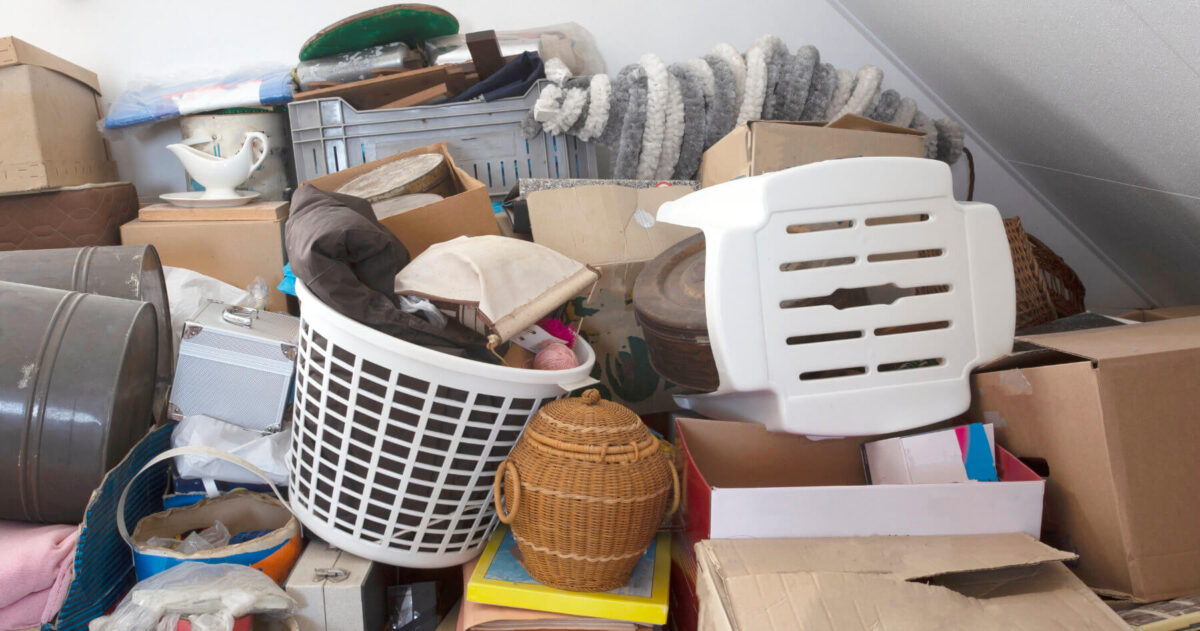
What our “stuff” tells us about ourselves
My relationship with stuff is fascinating.
I like to keep things organised, but I also really struggle to throw things away.
I also get VERY upset when people don’t take care of my things.
My emotional childhood memory
I have a vivid memory from childhood about my attachment to things…
I was about three or four, and went into the city on the train with my mum for some reason.
While we were there, she bought me a book – Mrs Tiggywinkle – and I love books, always have, so this was a real treat.
But on the train home, there was a conductor (back when they had those on trains) making faces at me through the door.
I’m sure he thought it was cute and funny.
But with my social anxiety, it just threw me completely.
I got very rattled, and I left Mrs Tiggywinkle on the train.
I was heartbroken, and honestly, I still am, to this day.
I’ve worked through this story many times, and it’s much less emotionally charged than it was.
But it still hurts.
Why does our stuff matter so much?
The question is why?
What is it about stuff that is so powerful emotionally?
1. It represents love
One person’s interpretation of this was that it represented my mum’s love, and she didn’t express it easily or very often.
And that was totally true.
But I think there’s more to it than that.
2. Stuff feels safe
“Stuff” represents certainty.
In a world full of confusing emotions, unpredictable situations, and difficult interactions, stuff is safe.
It’s a known quantity.
It doesn’t talk back. It doesn’t say mean things. It just is.
It’s predictable, and therefore it represents the experience my inner child craves.
To know where everyone and everything stands.
To not be caught off guard, taken by surprise, or thrown a curve ball.
Like we were so many times growing up in overwhelming, challenging households.
People are not as predictable as stuff
When you’re dealing with CPTSD or social anxiety, honestly, people are a lot to deal with.
They’re messy, confusing and ultimately uncontrollable.
And so we surround ourselves with stuff.
My husband is also a hoarder, but it’s mostly limited to his spaces.
You can’t even walk through his workshop for the stuff everywhere, and as much as tries to keep it tidy, it inevitably slips back into chaos.
I guess he’s not ready to deal with his “stuff” yet 😉
(Funny how we refer to our emotional baggage as “stuff”…)
My mother-in-law is an even worse hoarder, and was that typical little old lady surrounded by stacks of old newspapers that she couldn’t bear to throw away, until we had to rescue her from it all to avoid finding her squished under a pile of them one fateful day.
Other people don’t take care of my things
Additionally, when people don’t take care of our things, it feels like SUCH an affront in so many ways.
That they don’t care about our needs.
That they’re willing to destabilise our sense of safety.
They they simply don’t see stuff the same way we do.
It hurts, deeply.
How do we heal our relationship with stuff?
So what do we do about it?
In some cases, it’s about reaching a limit – a limit of how much mess you can tolerate, or of how many things you want to have to take care of.
Some days, I long for an empty white room, with a white bed and a white desk, and nothing else to have to be responsible for (sounds a bit like a padded cell!)
Some days I just want more, MORE, but I recognise that it’s my anxiety speaking, and I remind myself that more stuff won’t and doesn’t make me happy. (But I still want it.)
In some cases, it’s about facing the difficult process of getting rid of things.
And yet, to this day, I still regret throwing away my handmade wedding dress, but I was mad that it got moth-eaten, it cost me less than $100 to make, and what was I ever going to do with it?
Ugh, it’s so tricky sometimes…
I also allow myself small spaces around the house for things that are purely sentimental – a box in the storeroom, on the library shelves, a drawer in my bedroom – but I try to minimise it.
Because honestly, caring so much about stuff is also exhausting.
And yet so is going through it all, deciding what to keep and what to get rid of.
Sometimes we’ll go on big clean-out sprees, and we have relative order and space for a brief period, and then we go back to allowing stuff to accumulate.
I burn essential oils when it comes time to clean out a room a cupboard or the hallway (for the millionth time), to try and help process the emotions.
I try to focus on the joy of a clean and tidy space, and the burden that clearing stuff out lifts.
I try to donate where I can, and we reuse and recycle like crazy, so it feels less wasteful.
And I try to find security inside of myself – reminding myself of the things I know how to do, the way I see the world, or the confidence that I can handle almost anything that comes my way – instead of staying attached to the things I possess.
But finding the balance is not easy.
All I can do for now is remain aware of this fascinating dynamic, and balance my conflicting needs for safety and relief, one thing at a time.
A quick recap
- We learn to equate material things with safety
- We struggle to let go of things because it feels destabilising
- It’s upsetting when other people aren’t careful with our stuff
- Stuff takes energy to look after, but we crave it nonetheless
- We need to experiment to find the things that work to shift our relationship with our stuff
- We need to find safety in things that aren’t “stuff”
What next?
- Take a look at the space around you right now. What does it tell you about your relationship with stuff?
- Do you have a tricky relationship with stuff? Or do you not understand why stuff matters so much to others?
- Do you struggle to let go of things? What have you found works for you?
What are your best tips and tricks for keeping a handle on your stuff?
And remember to grab your freebie to help you manage your emotions tangled in with your possessions.
Have a wonderful day.
Nicola


